• Logo
    PaperBananaAI Academic Illustration Generator
Home
  • Home
  • Studio
  • Scientific Illustration Generator
  • Poster Maker
  • Diagram Maker
  • Figure Editor
  • Pricing
My Creations
  • My Creations
  • Invite Friends
LogoPaperBanana
HomePricingInvite Friends
LogoPaperBanana

PaperBanana - AI-powered academic illustration generator

support@paperbanana.me
All Tools

Tool directory

AI creation

  • Scientific Illustration
  • Graphical Abstract Maker
  • Scientific Poster Maker
  • Diagram Maker
  • Figure Editor

Diagrams & organizers

  • Conceptual Framework Generator
  • Graphic Organizer Maker
  • Frayer Model Maker
  • KWL Chart Maker
  • Cause and Effect Graphic Organizer
  • Compare and Contrast Graphic Organizer
  • Spider Diagram Maker
  • Plot Diagram Maker
  • Factor Tree Generator
  • Number Line Generator
  • Free Body Diagram Maker
  • PRISMA Flow Diagram Generator
  • Venn Diagram Maker
  • CONSORT Flow Diagram Generator

Data visualization

  • Scatter Plot Maker
  • Dot Plot Maker
  • Forest Plot Maker
  • Funnel Plot Maker
  • Kaplan-Meier Curve Maker
  • Box Plot Maker
  • Heatmap Generator
  • Volcano Plot Generator
  • Phylogenetic Tree Generator

Publishing tools

  • Free Journal Figure Checker
  • Free Image Format Converter
  • Free Tools
  • Prompts

© 2026 PaperBanana. All Rights Reserved.

Support

  • About
  • Pricing
  • Contact

Legal

  • Privacy Policy
  • Terms of Service
  • Acceptable Use
PricingContact
Online factor tree calculator

Free Factor Tree Generator

Use this Factor Tree Generator to build a visual prime factor tree and see every split. Add a second number to compare prime exponents and find GCF and LCM.

Live visual factor treeExpanded and exponent formChoose different factor pairsPrintable worksheet modeTwo-number GCF and LCM comparison

Interactive number playground

Choose a number

Use any whole number from 2 to 9,999,999. Choose a starting factor pair, or add a second number to find GCF and LCM from prime exponents.

Whole numbers from 2 to 9,999,999 are supported, including prime numbers such as 97 and 211.

Quick examples

Choose the first split

Everything is calculated in this browser. Your numbers are not uploaded or saved.

Updates live

Factor tree preview

Factor tree preview
Factor tree for 60A visual factor tree that breaks 60 into prime-number leaves.60 = 2² × 3 × 560 — composite node606 — composite node610 — composite node102 — prime leaf23 — prime leaf32 — prime leaf25 — prime leaf5Factor Tree Generator · PaperBanana

Expanded form

2 × 2 × 3 × 5

Exponent form

2² × 3 × 5

Distinct primes

3

See every factor split
  1. 1.60 = 6 × 10
  2. 2.6 = 2 × 3
  3. 3.10 = 2 × 5

Factor tree basics

What Is a Factor Tree and How Does It Work?

A factor tree is a branching diagram that breaks one composite whole number into smaller factor pairs. Each composite branch keeps splitting until every leaf is prime. Reading those leaves from left to right gives the number's prime factorization in expanded or exponent form.

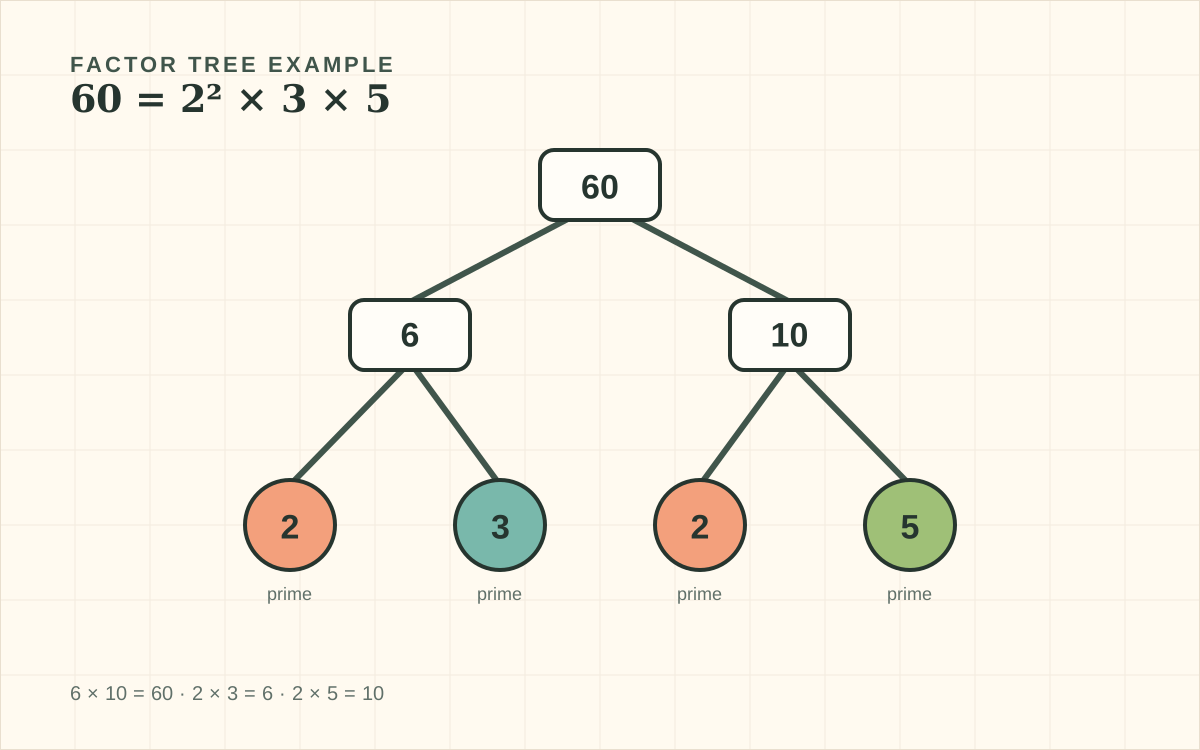
The leaves give the prime factorization. For example, 60 can split into 6 × 10, then into 2 × 3 and 2 × 5, so 60 = 2 × 2 × 3 × 5 = 2² × 3 × 5.

One number can have several correct factor trees because you may choose different factor pairs at the first or later steps. The shape can change, but the final set of prime factors is always the same.

01

Start with a composite number

Place the number at the root and choose any factor pair greater than 1.

02

Split composite branches

Keep factoring a branch while its number has more than two positive factors.

03

Stop at prime leaves

A prime number cannot be split into smaller whole-number factors.

04

Check the product

Multiply all prime leaves. Their product must equal the original number.

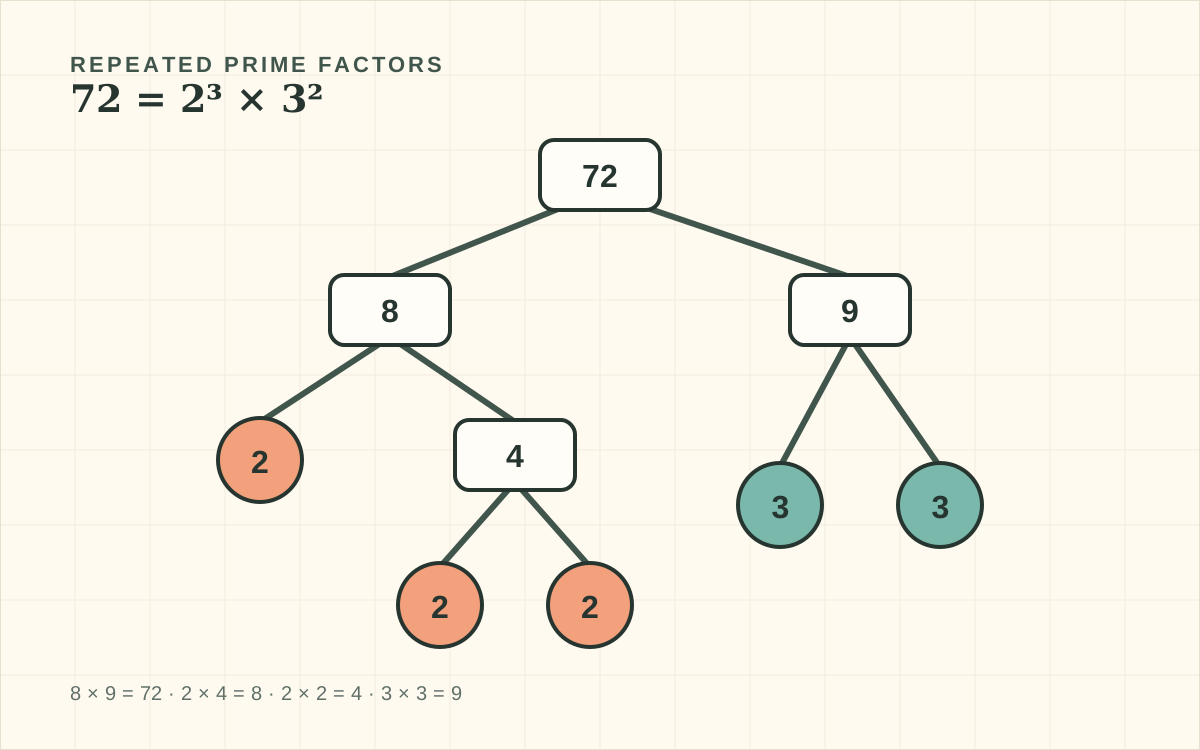
Prime Factor Tree Examples for 60, 72, 100, and 360

Start with common homework numbers, compare their tree depth, and then replace the value with your own.

For learning and teaching

Factor Tree Worksheets for Students, Parents, and Teachers

Generate an answer, check a student's own branches, or turn the same tree into a printable practice sheet.

Student arranging colored number tiles into a factor tree for 60

Learn by choosing factor pairs

Pick the first split yourself and see how a different pair changes the tree without changing the final prime factorization.

Worked factor tree of 72 with composite nodes and colored prime leaves

Check homework with a parent or tutor

Compare every parent with its two children, find the exact split that went wrong, and avoid checking only the final answer.

Printable factor tree worksheets and completed answer key on a teacher desk

Print worksheets and answer keys

Hide prime leaves, print a clean practice tree, and switch back to answer mode when it is time to review.

More than a factor calculator

Factor Tree Calculator With GCF and LCM Comparison

Get a correct result quickly without hiding the mathematical structure that students need to understand.

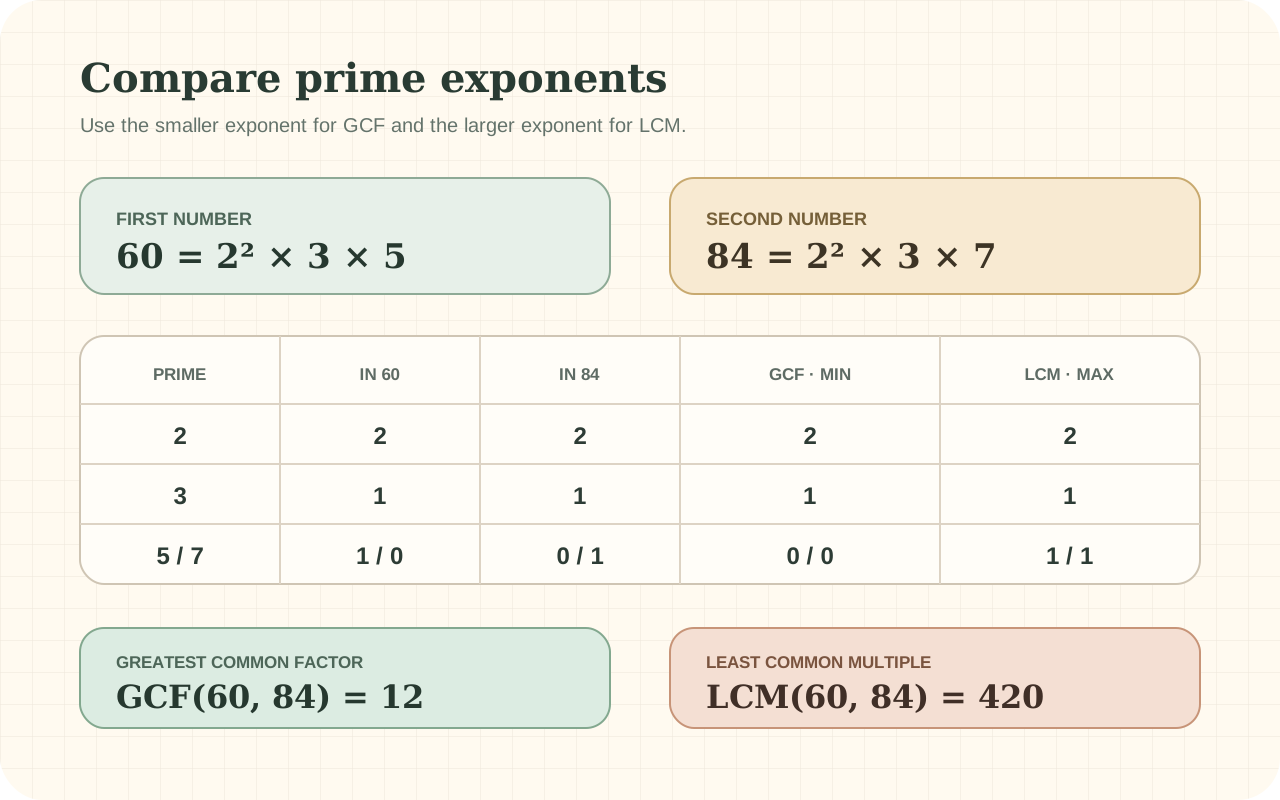
Compare two numbers to find GCF and LCM

Add an optional second integer to factor both numbers side by side. The exponent table aligns every prime, highlights the smaller exponent used for GCF and the larger exponent used for LCM, and calculates both results instantly.

Open the Factor Tree Generator
Prime exponent table comparing 60 and 84 with GCF 12 and LCM 420

Compare different valid factor trees

Choose among every available first factor pair. The branches redraw while the expanded and exponent forms stay consistent.

Open the Factor Tree Generator
Factor tree of 60 created from the factor pair 6 and 10

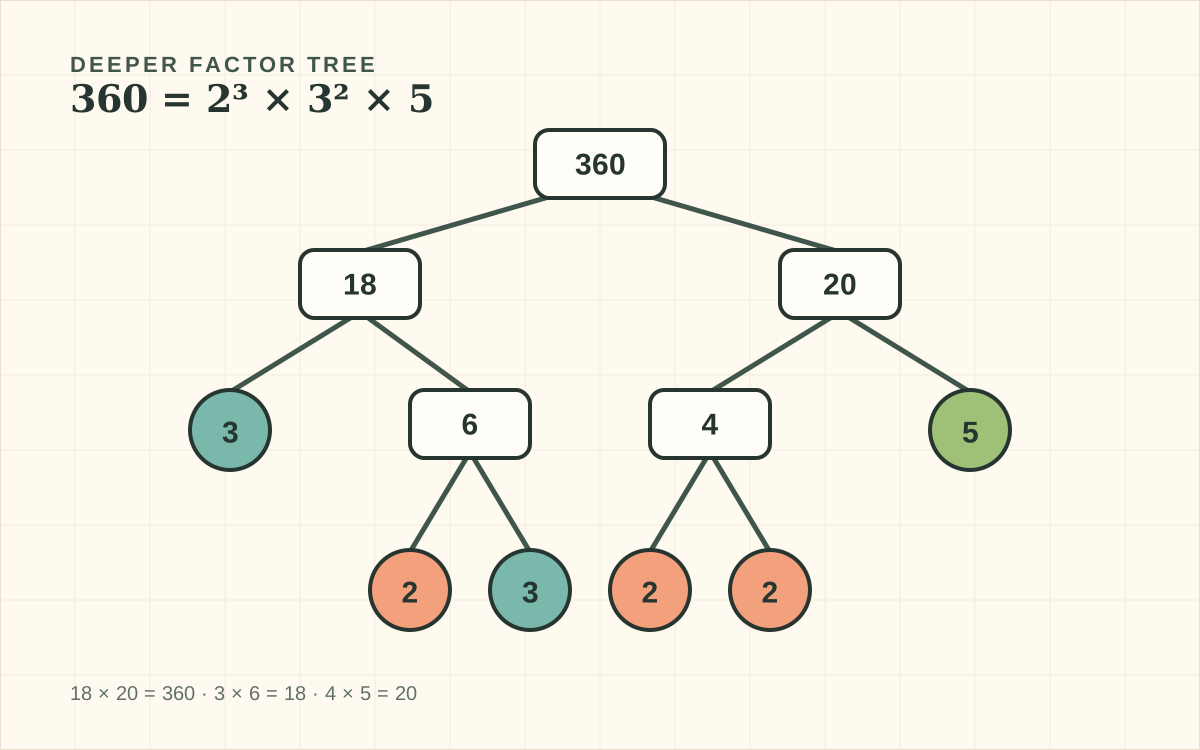
Handle repeated primes and deeper trees

The generator calculates factors algorithmically up to the square root, so prime inputs such as 211 and larger classroom examples do not depend on a short hard-coded prime list.

Open the Factor Tree Generator
Deep factor tree of 360 with repeated prime factors

Export an answer or a practice sheet

Download SVG or PNG, copy the prime factorization, or print a worksheet with blank prime leaves and no watermark.

Open the Factor Tree Generator
Printable factor tree practice pages with colored answer key
Built for correct math

Check Prime Factorization Step by Step

A factor tree is useful only when every split is valid and every final leaf is prime. The generator checks those rules automatically without guessing or calling an AI model.

Dynamic prime checking

Potential divisors are tested only up to the square root, so primes are recognized without relying on a fixed list.

Product verification

Each pair multiplies to its parent, and all prime leaves multiply back to the root number.

Clear edge-case explanations

Prime numbers, 1, decimals, empty values, and out-of-range inputs receive a specific explanation instead of a blank result.

Student building a mathematically correct factor tree with number tiles
The diagram is calculated locally with deterministic number rules, not generated from a probabilistic answer.Math checked

Why use this generator

Why Use a Visual Prime Factorization Calculator?

Use one lightweight tool for practice, explanation, checking, and classroom-ready output.

Step by step

See the full factorization path

Trace each composite number to its children instead of receiving an unexplained list of primes.

Multiple trees

Learn that trees can differ

Switch the first factor pair and compare another correct route to the same unique prime factorization.

Two forms

Read both answer forms

Use expanded form for counting repeated primes and exponent form for compact final answers.

Two-number compare

Connect factor trees to GCF and LCM

Compare two prime factorizations in one exponent table and see exactly why GCF takes minimum powers while LCM takes maximum powers.

Practice mode

Practice without revealing leaves

Worksheet mode blanks the prime leaf values while keeping the tree structure ready to solve.

SVG + PNG

Keep diagrams sharp

SVG stays crisp in worksheets, slides, and lesson materials; PNG is ready for everyday documents.

Browser only

Work privately without signup

The calculation runs in your browser, and exporting a diagram does not require an account.

Three simple steps

How to Make a Factor Tree Online

Enter a number, choose a factor pair or add a comparison number, then review and export the completed prime factorization.

01

Enter a whole number greater than 1

Use a homework value, a quick example, or the Random button. Prime numbers are identified immediately.

02

Choose a split or compare two numbers

For a composite number, keep the balanced split or select another valid pair. Add a second number when you also need GCF and LCM.

03

Review, download, or print

Check each multiplication statement and both factorization forms. Save an SVG or PNG answer, or print Worksheet mode with blank prime leaves.

Use Factor Tree Generator
Teacher desk with factor tree practice worksheets and answer key
Worksheet mode keeps the branch structure visible while hiding prime leaves for students to complete.

More visual learning tools

More Math Graphic Organizers and Diagram Tools

Build another classroom visual, compare concepts, or turn a process into a clear diagram.

Editable classroom graphic organizer

Graphic Organizer Maker

Create editable visual organizers for concepts, evidence, vocabulary, and lesson planning.

Venn diagram comparing two topics

Venn Diagram Maker

Compare two or three sets with a familiar overlap diagram.

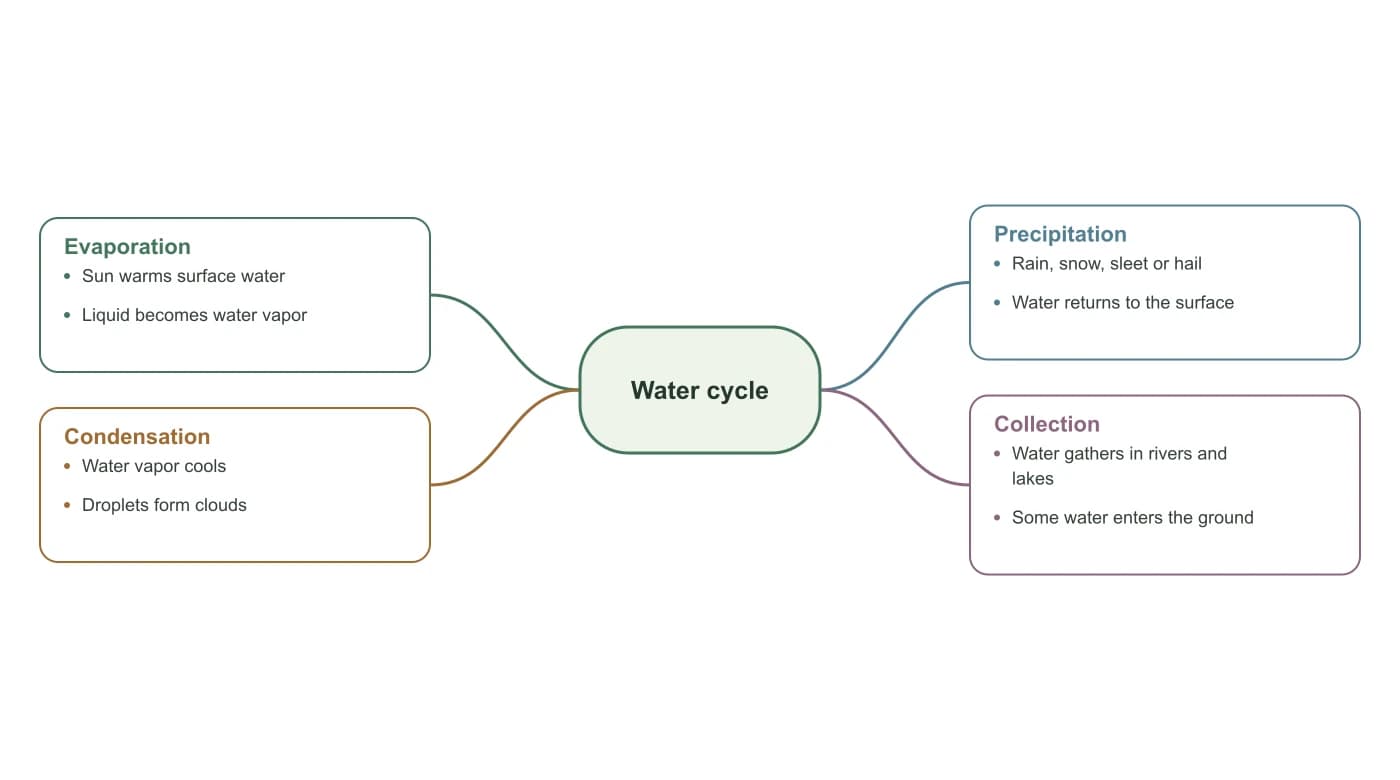
Spider diagram about the water cycle

Spider Diagram Maker

Expand one central topic into connected facts, examples, and ideas.

Editable visual diagram with connected nodes

Scientific Diagram Maker

Build a custom editable diagram when you need complete control over shapes and connectors.

Factor tree questions

Factor Tree Calculator FAQ

How do you make a factor tree?+

Write the composite number at the top, choose any factor pair greater than 1, and draw those two factors as branches. Repeat the process for every composite factor. Stop only when every final leaf is prime, then multiply the prime leaves to check that they equal the original number.

Can a number have more than one factor tree?+

Yes. A composite number may have several factor pairs, so different first splits can create different tree shapes. For 60, you could begin with 6 × 10, 4 × 15, or 3 × 20. Every valid completed tree still ends with the same unique prime factorization: 2² × 3 × 5.

What happens if the number is already prime?+

A prime number has no factor pair other than 1 and itself, so it cannot branch into smaller whole-number factors. The generator shows it as one labeled prime leaf instead of returning an error. For example, the complete prime factorization of 97 is simply 97.

Why is 1 not included as a prime factor?+

The number 1 is neither prime nor composite. A prime number must have exactly two positive factors: 1 and itself. Including 1 as a prime factor would also make every factorization endlessly repeatable, because any product could contain an unlimited number of extra factors of 1.

Can I use decimals or negative numbers?+

This classroom generator accepts positive whole numbers greater than 1. Standard factor trees describe integer prime factorization, so decimals are not valid inputs. A negative integer can be written with an additional factor of −1, but the visible tree normally uses its positive part.

How do factor trees help find GCF and LCM?+

Turn on Compare two numbers and enter the second integer. The generator factors both numbers and aligns every prime in an exponent table. GCF multiplies shared primes using the smaller exponent; LCM uses every prime with its larger exponent. For 60 and 84, the tool shows GCF = 12 and LCM = 420.

What is the difference between a factor tree and the ladder method?+

A factor tree splits a number into two factors at each branch, so you can see how composite parts connect. The ladder method repeatedly divides the number by primes in a vertical list. The layouts differ, but both methods produce the same prime factorization when completed correctly.

Can I print a blank factor tree worksheet?+

Yes. Switch the preview to Worksheet mode to hide the prime leaf values while keeping the branch structure. Print that version for a paper exercise, then return to Answer mode to review the completed factor tree. You can also download SVG or PNG files for lesson materials.

Start with any whole number

Turn a number into a factor tree you can learn from

Choose a factor pair, compare two numbers for GCF and LCM, then download the answer or print a practice worksheet.

Use Factor Tree Generator