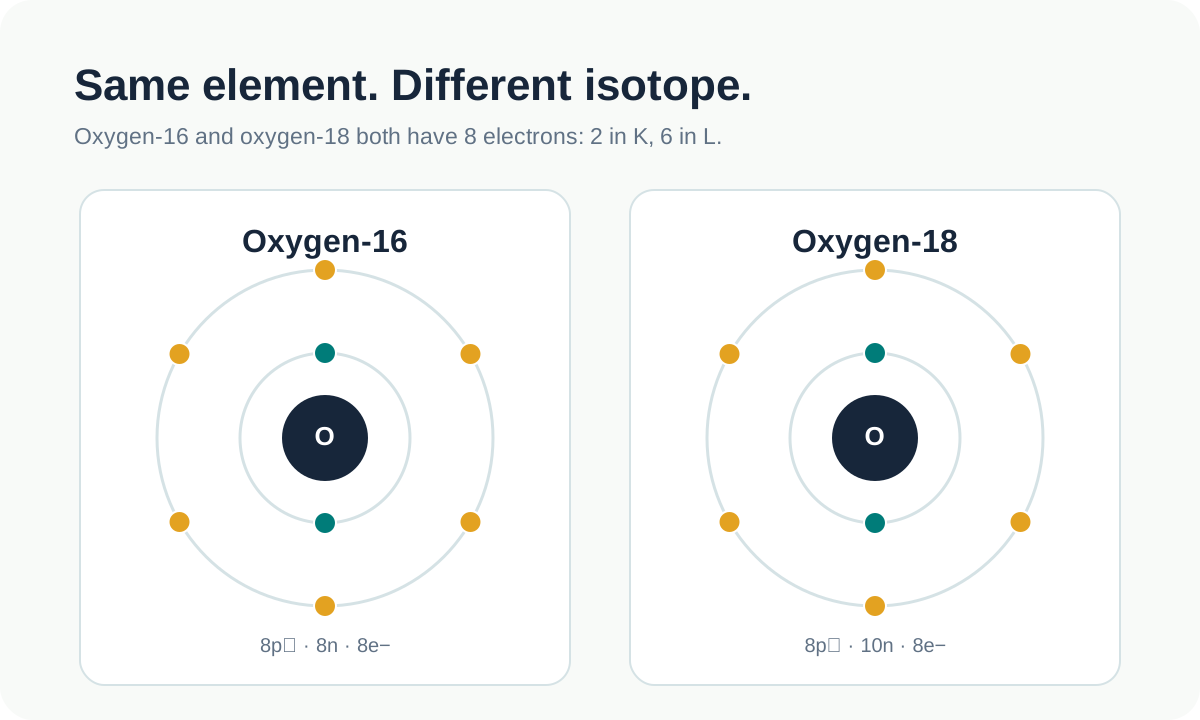
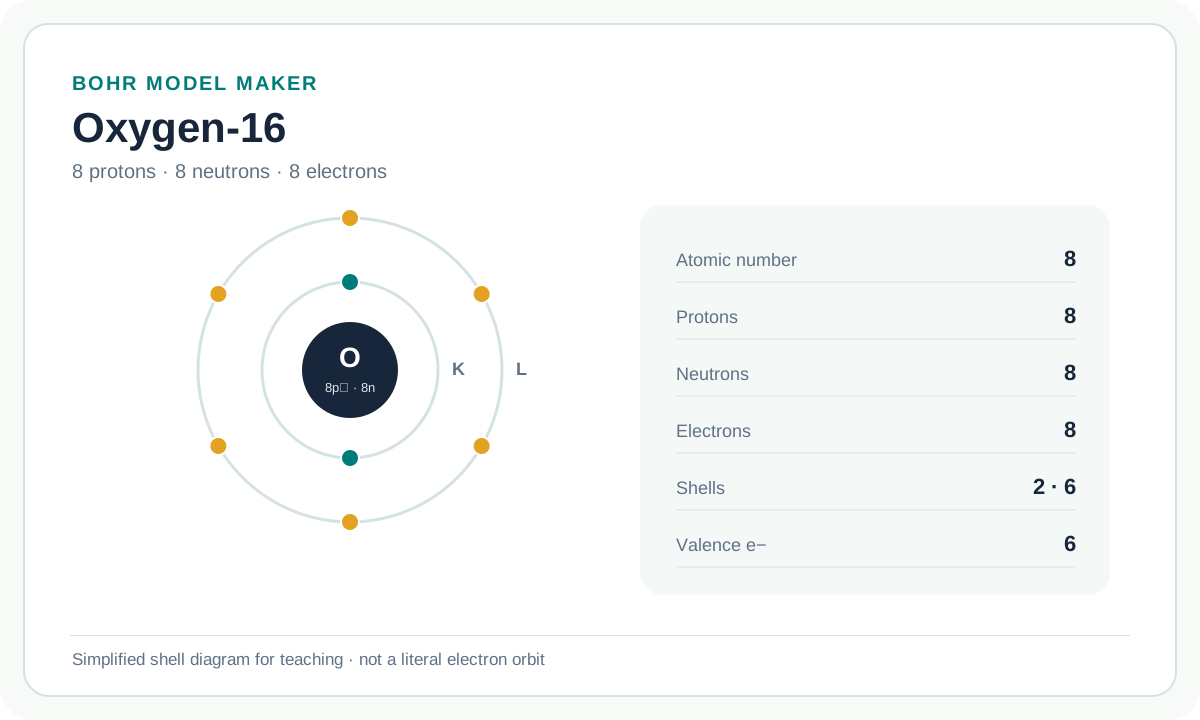
A Bohr model is a simplified atom diagram: a nucleus at the center and electrons shown as dots on surrounding shells. It helps students see how atomic number determines proton count and, for a neutral atom, electron count.
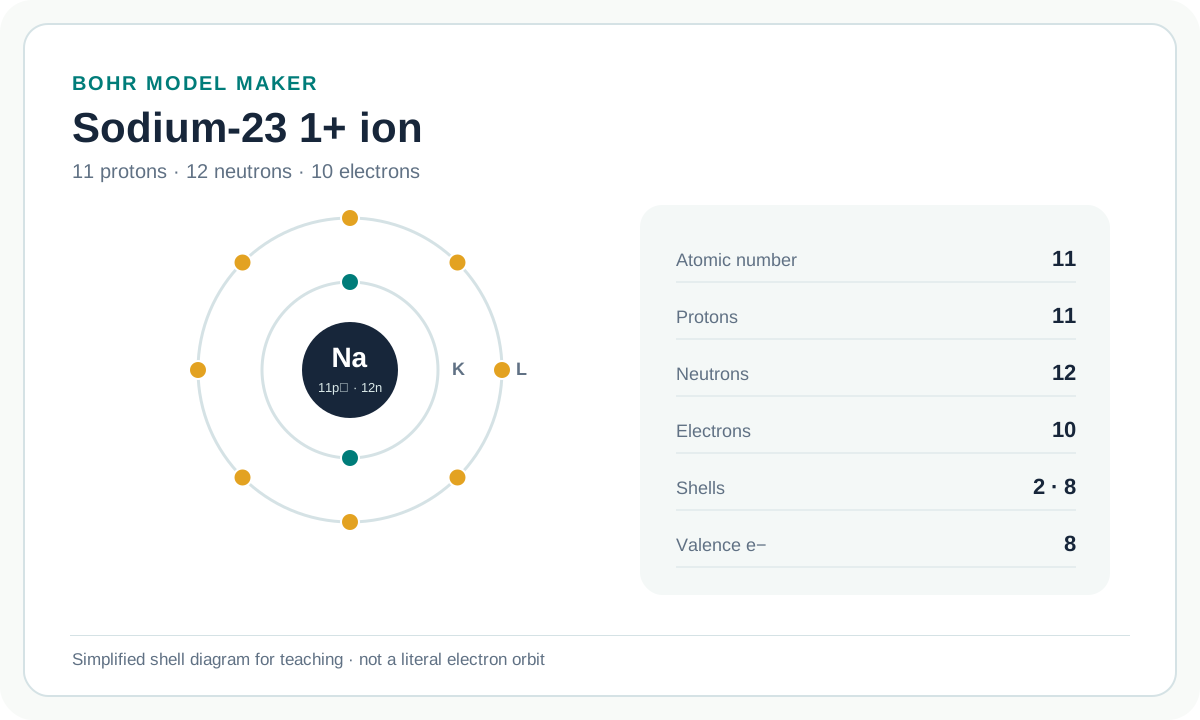
The mass number identifies an isotope. Subtract the atomic number from that mass number to find its neutrons. An ion changes the electron total without changing the nucleus: sodium has 11 electrons when neutral but 10 as Na⁺.
This Bohr model maker covers the first 36 elements as neutral atoms, with ground-state electrons grouped by shell. For elements 1–20 you can also set an ion charge. The rings are a classroom picture of electron energy levels, not a literal path of orbiting particles.
Nucleus
Atomic number gives protons; isotope mass number minus atomic number gives neutrons.
Electrons
A neutral atom has one electron per proton; changing charge changes the electron total.
Shells
Dots are grouped into K, L, M and N shells using the supported ground-state configuration.
Outer shell
The outermost occupied shell is highlighted so its electrons are easy to count; transition-metal bonding also involves inner d electrons.