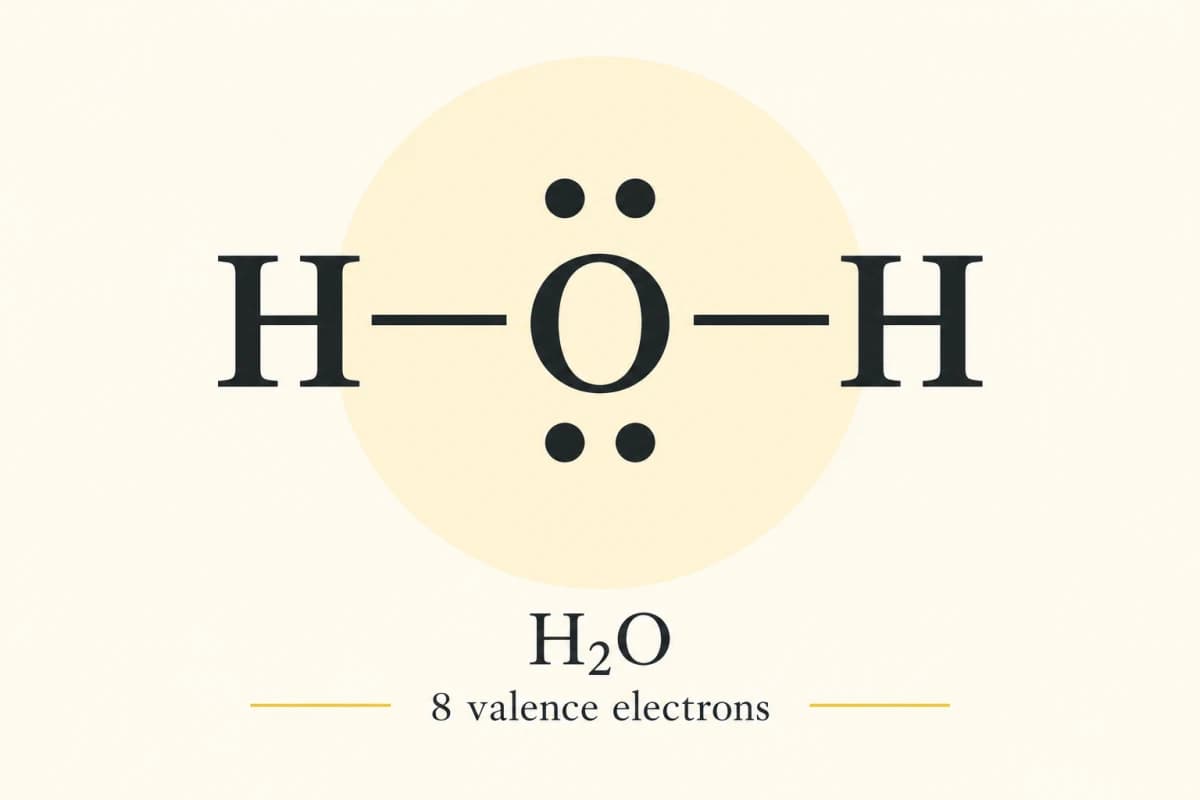
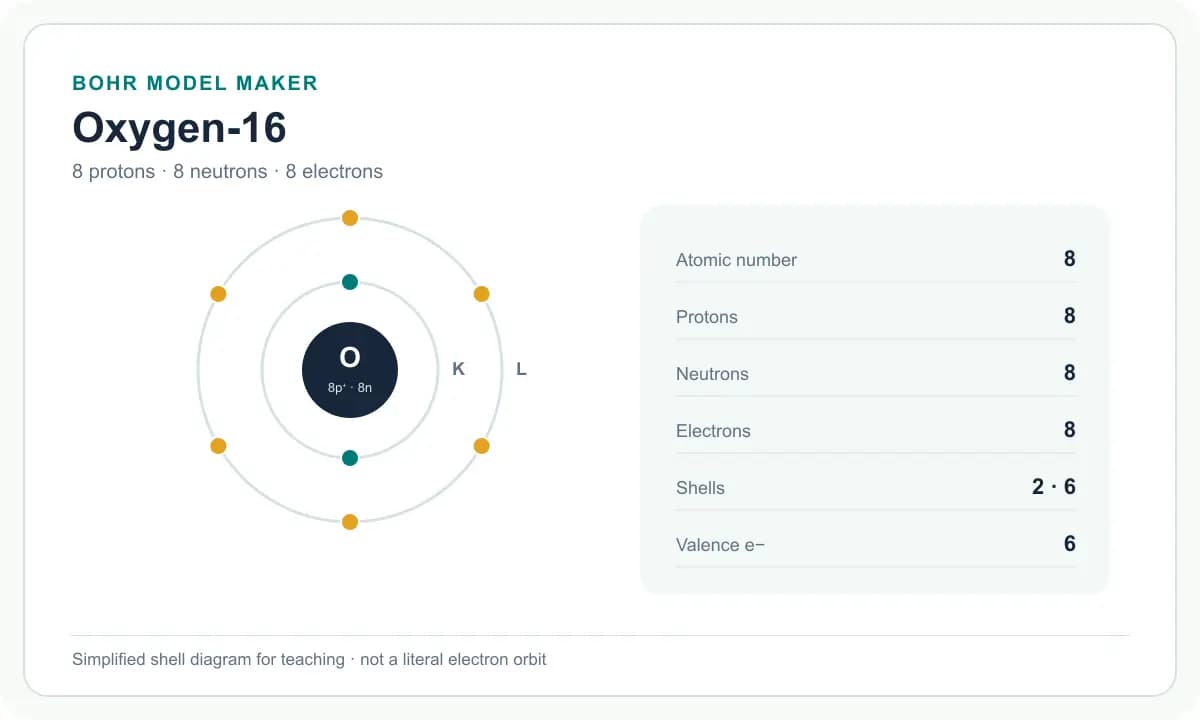
O₂
First species
- Bond order
- 2
- Unpaired e⁻
- 2
- Magnetism
- Paramagnetic
- 2p orbital order
- σ2p below π2p
Use this Molecular Orbital Diagram Generator to draw and compare qualitative ground-state diagrams for supported diatomic molecules and ions. Check electron arrows, σ/π order, bond order and magnetism, then export SVG or PNG in your browser without an account.
From formula to orbital diagram
Try a supported species
Supports neutral H₂–Ne₂ homonuclear diatomics plus H₂⁺, N₂⁺, O₂⁺, O₂⁻ and O₂²⁻. Only qualitative ground-state valence orbitals are shown; energy spacing is schematic.
Calculated locally in your browser. No account, credits or watermark.
Molecular orbital diagram
Bond order: 2
Magnetism: Paramagnetic
Bond order: (8 − 4) ÷ 2 = 2
2p orbital order: σ2p below π2p
MO occupancy: σ2s2 · σ*2s2 · σ2p2 · π2p4 · π*2p2
Qualitative ground-state teaching diagram. Orbital heights are schematic, not measured energies. A bond order of zero is a simple-model result; this tool does not calculate molecular stability.
Compare two molecules
Choose a second supported species to inspect two complete MO diagrams on the same screen. Compare σ/π ordering, bond order, unpaired electrons and magnetism, then download one combined SVG or PNG sheet.

Qualitative ground-state teaching diagram. Orbital heights are schematic, not measured energies. A bond order of zero is a simple-model result; this tool does not calculate molecular stability.
Turn your research methods, mechanisms, and workflows into clear figures with paper banana.
A molecular orbital (MO) diagram shows how atomic orbitals combine into bonding and antibonding levels. Electrons occupy the lower-energy levels first; paired and unpaired arrows help explain bond order and magnetic behavior.
For B₂, C₂ and N₂, s–p mixing places π2p below σ2p. For O₂, F₂ and Ne₂, σ2p sits below π2p. This generator uses the corresponding teaching order for the supported species and shows the calculation beside the diagram.
Load a molecule to compare electron filling, bond order and magnetism. Each example image is rendered from the same rule engine as the live tool.
Chemistry work
Read the occupancy and calculation alongside a diagram you can reuse.
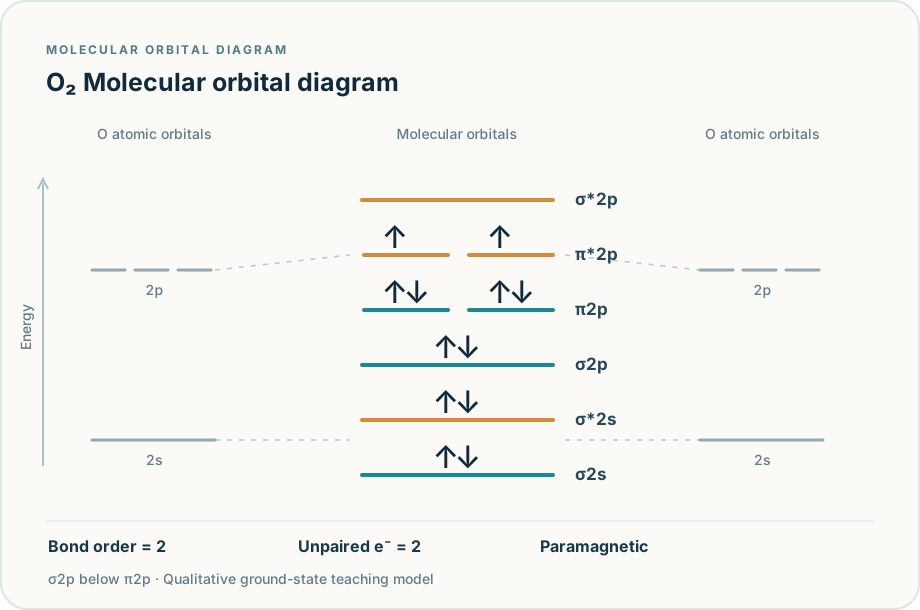
Compare an O₂ or F₂ assignment with electron arrows, bond order and magnetic behavior before submitting.
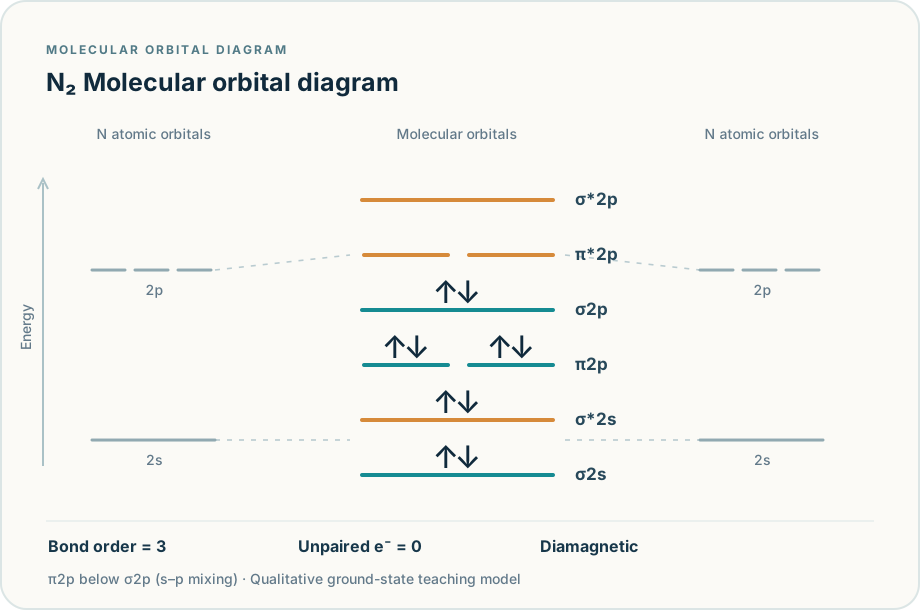
Switch supported formulas and export a clean vector diagram instead of redrawing every energy level.
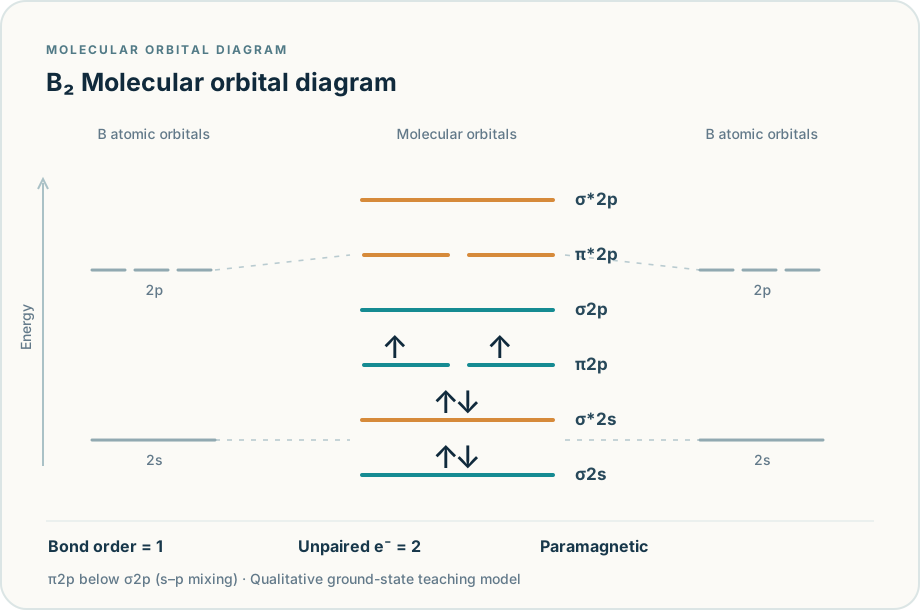
Show why B₂ and O₂ are paramagnetic while N₂ is diamagnetic, using diagrams with a consistent visual scale.
Checkable results
The diagram and its numerical summary come from the same local calculation.
The supported B₂, C₂ and N₂ species use the s–p mixing order. O₂, F₂ and Ne₂ use the other order. The active order is stated next to the result.
Try Molecular Orbital Diagram GeneratorInspect bonding and antibonding counts, the occupancy of each orbital and the number of unpaired electrons. Bond order is half their difference.
Try Molecular Orbital Diagram GeneratorDownload the rule-generated figure as SVG or PNG without a watermark. Unsupported formulas receive a clear message instead of a guessed drawing.
Try Molecular Orbital Diagram Generator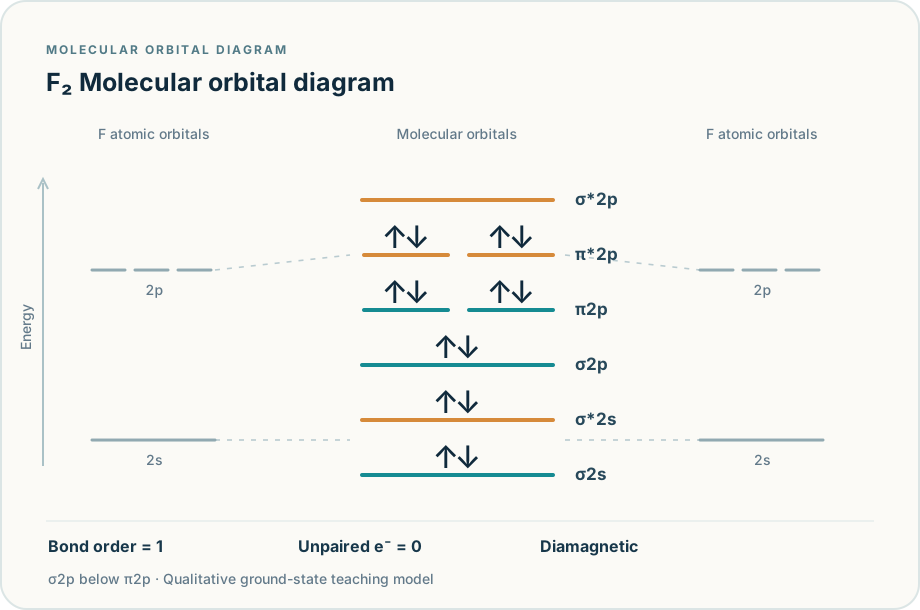
Place two supported MO diagrams side by side, compare their orbital order, bond order, unpaired electrons and magnetism, and download one combined SVG or PNG comparison sheet.
Try Molecular Orbital Diagram Generator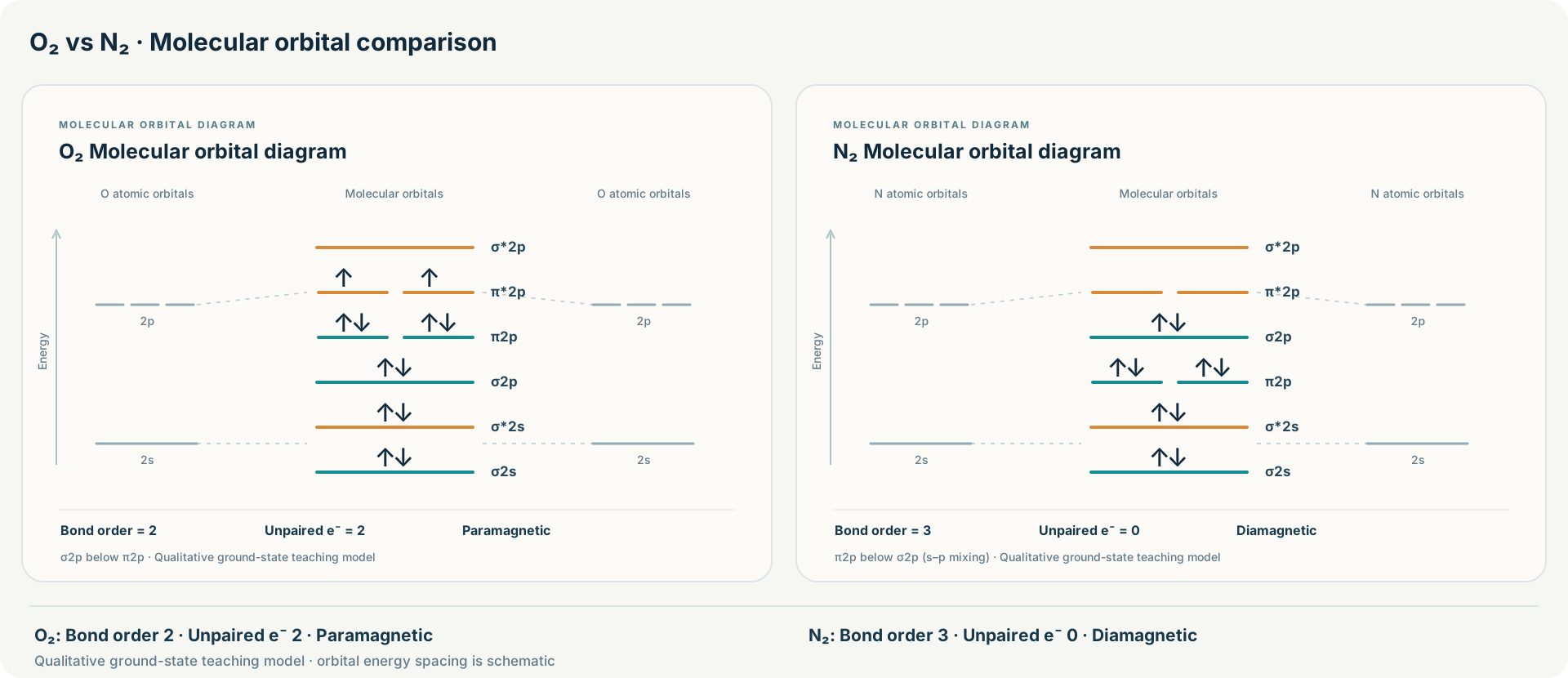
Three steps
Select a supported formula, inspect the electron filling and calculation, then export the same diagram.
Enter O2, N2, F2 or a listed ion such as O2-. The supported list prevents guessed orbital schemes for other molecules.
Check the σ/π order, occupancy arrows and bonding versus antibonding electron totals. The tool computes bond order and unpaired electrons.
Use the vector diagram in a worksheet, report or slide. Keep the qualitative-model note with the figure when precision matters.
More chemistry tools
Use the right representation for each question.
Questions
Choose O₂ or N₂ in the generator and select Generate MO Diagram. The tool fills supported ground-state valence orbitals from lower to higher energy, places electrons singly in degenerate π orbitals before pairing, and shows the completed energy diagram with electron counts, bond order and magnetism.
In this qualitative teaching model, s–p mixing puts π2p below σ2p for the supported B₂, C₂ and N₂ species. For O₂, F₂ and Ne₂, σ2p sits below π2p. The generator labels the order used for each result, so you can compare the two diagrams directly.
Subtract the number of antibonding electrons from bonding electrons, then divide by two: bond order = (bonding − antibonding) ÷ 2. For each supported species, the result panel lists both electron counts and the calculated bond order beside the orbital diagram. Compare two species to see how electron filling changes that value.
CO and NO are heteronuclear molecules and require a different orbital-energy treatment from this tool’s supported homonuclear teaching set. The generator accepts listed neutral diatomics from H₂ through Ne₂ plus H₂⁺, N₂⁺, O₂⁺, O₂⁻ and O₂²⁻. Unsupported formulas produce a clear message instead of a guessed diagram.
This generator shows qualitative ground-state occupancy for its supported species. It does not let you set spin multiplicity, move electrons into an excited configuration, or calculate quantum-chemical orbital energies. Use the displayed energy levels as a teaching schematic and verify any excited-state assignment with a method designed for that problem.
Download the generated diagram as SVG for a scalable figure or PNG for slides and worksheets at no charge. The same formats are available for a side-by-side comparison sheet containing two supported species. Generation and export run in your browser without an account, credits or a watermark; review the qualitative-model note before scientific reuse.
Generate the first supported molecule or ion, then choose another species in the comparison panel. Both diagrams appear side by side with their σ/π ordering, bond order, unpaired electrons and magnetism. Download comparison SVG or PNG to place the two diagrams on one sheet for a chemistry worksheet, report or lesson.
Open the O₂, N₂, F₂ or B₂ example cards to load that species into the generator. O₂ shows two unpaired π* electrons and paramagnetism; N₂ has bond order 3; F₂ has bond order 1; B₂ has unpaired π bonding electrons. Each diagram can be downloaded as SVG or PNG.
Start with a supported species
See occupancy, bond order and magnetic behavior in one checkable diagram, then download it for your chemistry work.